
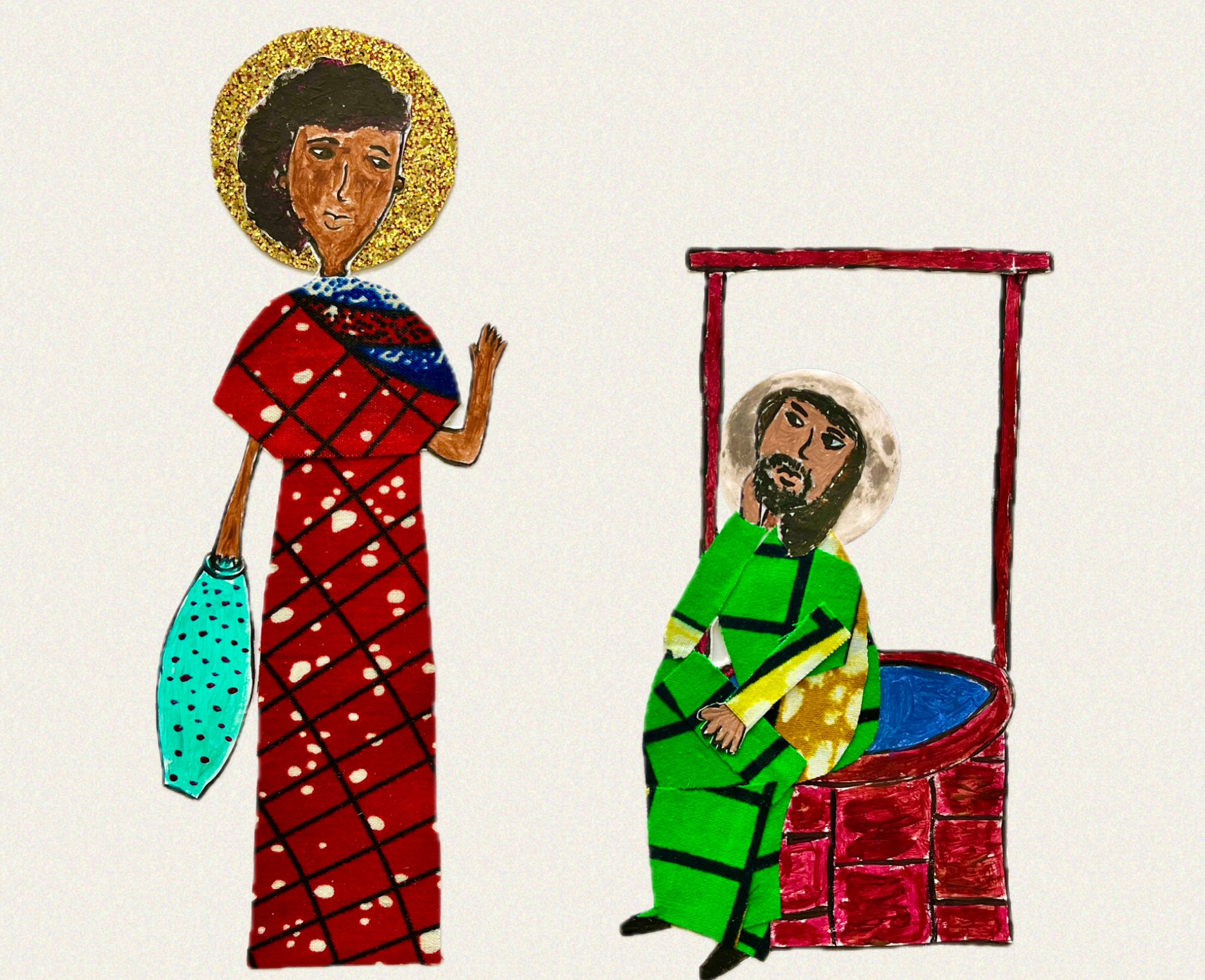
Well, Water
In traditional Western ideology and the 66 Book Protestant Bible, the Samaritan Woman at the Well (Gospel of John ch 4) is read as a woman without a name who went to the well for water, and Jesus, in turn, surprised the woman, exposing her relationships with different men. The Samaritan woman received the rebuke and left with the “living water,” that is–Jesus’ enlightenment for her to live a new life and to go and spread the Gospel message. Traditional iconography following Eastern Orthodoxy names this woman St Photini, “the enlightened one,” whose story is extended to include her life spreading the Good News with her sons and sisters, resulting in martyrdom.
Scholars and other religious interpreters within the West have worked to reject the narrative that positions the Samaritan woman as a shameful whore. They provide insight for viewing her as fully human with agency and good character. Byzantine Hoodoo adopts and then extends these liberating interpretations, first pointing folks to the recurring theme of the Hebrew Bible where a woman goes to a well, meets a man, and is left changed. BH then asks folks to release the conversations that happen at each of these well encounters–that took place between St Photini and Jesus. Next, it asks folks to re-imagine this as a metaphor–a woman goes to the water/man, and something is created/birthed from their exchange.
Byzantine Hoodoo sees these stories aligned with the 12 Universal Laws– particularly the Law of Gender–explaining the balancing act of masculine and feminine energy. It invites readers back to the Hebrew Bible Genesis creation narrative, where the Cosmic Sky hovered over the Water, and from it the Earth was born. (Divine Feminine energy + Masculine Energy = relational/reciprocating energy and creativity) – The woman with her jar received the water from the man, and poured out or gave birth to a movement among creation.*
So to pick up from Part 1 in the description of St Thecla:**
If we approach our natural resources from a relational, balanced energy, the results are balanced and reciprocated among creation. However, if we approach our resources from a history of competitive greed and exploitation (imbalanced masculine energy), the results bear similar fruit–calling for a balancing act of energy, attitudes, and emotions that can fuel our actions into a life considering how to best live in goodness, abundance, and reciprocity with all of creation. Meditation and breath work, contemplative movement, dance, yoga, visual art and craft practices, writing/journaling, gardening, cooking, visiting energy and spiritual practitioners, therapy and psychological treatment (if/when needed) – are all examples of how one can set intention to scan their internal body, to ensure external responses are healthy for personal and communal wellness/wholeness.
You can check out the energy meditation resource guide here, which grounds the work of Byzantine Hoodoo.
*Some interpretations (not accepted among the mainstream) view these “well” stories as an intimate metaphor, with Jesus and the woman flirting, often rooted in the Greek culture of the time; however, I have not come across any that relate these stories to the creation narrative or the law of feminine and masculine energy.
**This is part 2/2 of a conversation about clean water, climate change, environmental justice advocacy, etc. For part 1, please see the description for St. Thecla.