
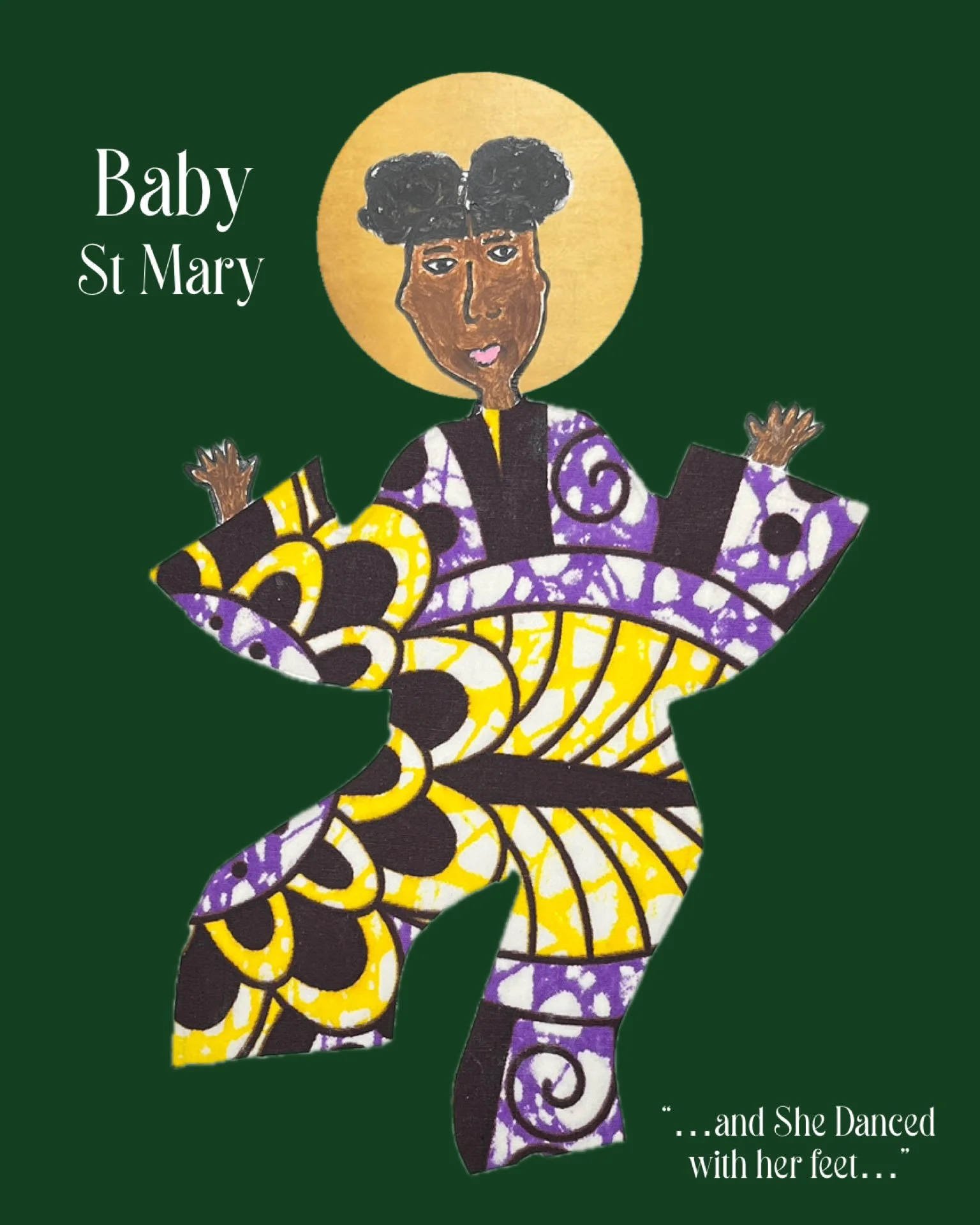
Baby St Mary
“...and she danced with her feet…”
The Protoevangelium of James is a non-canonical text (not included in any traditional Bible) that describes the life of Mary, the mother of Jesus. It begins with her parents, Anna and Joachim, praying for Mary’s conception and follows her as she hides baby Jesus while fleeing the social terror of King Herod. In this text, Mary is portrayed as laughing and given greater depth of personality and story. She was loved and nursed by her parents until the age of three, when she was then given over to God to live in the temple for nine years, growing in spiritual maturity. As her parents brought her before the leaders, she leaped from her mother’s breast, “and she danced with her feet.”
The Byzantine Hoodoo icon Baby St Mary reflects this dancing toddler with her hands in orans,* imagining Mary’s movement as a channel of celebration and prayer for what would come of her life. It imagines that Mary and Elizabeth shared a prayerful dance in their text after awing over what would come from the forces in their wombs. It imagines Mary might have danced when her baby was born and when they returned safely from exodus, having beaten the odds. It imagines that Mary might have danced when she learned that her son had escaped the injustice of the penal punishment of the day. It imagines Baby St Mary’s dance is likened to the prayerful resistance of the enslaved doing the Ring Shout in the Brush Harbors or the swaying movement of Black Church Mothers “putting on the basileia”**–bringing the goodness of heaven to a social order in need of systematic reform.
So may we all find moments to dance, move, laugh, and play–as prayerful nourishment for our souls–while we work towards liberty and justice for all.
*orans is a common gesture found in early iconography, where the human is holding their hands up as a sign of prayer
**Marshall Turman, Eboni. “Moving Heaven and Earth: A Womanist Dogmatics of Black Dance as Basileia” in Union Seminary Quarterly Review, vol. 65, no. 1&2, 2015. Christopher Morse, Heather Wise, and Jason Wyman, eds. p. 122-139.