
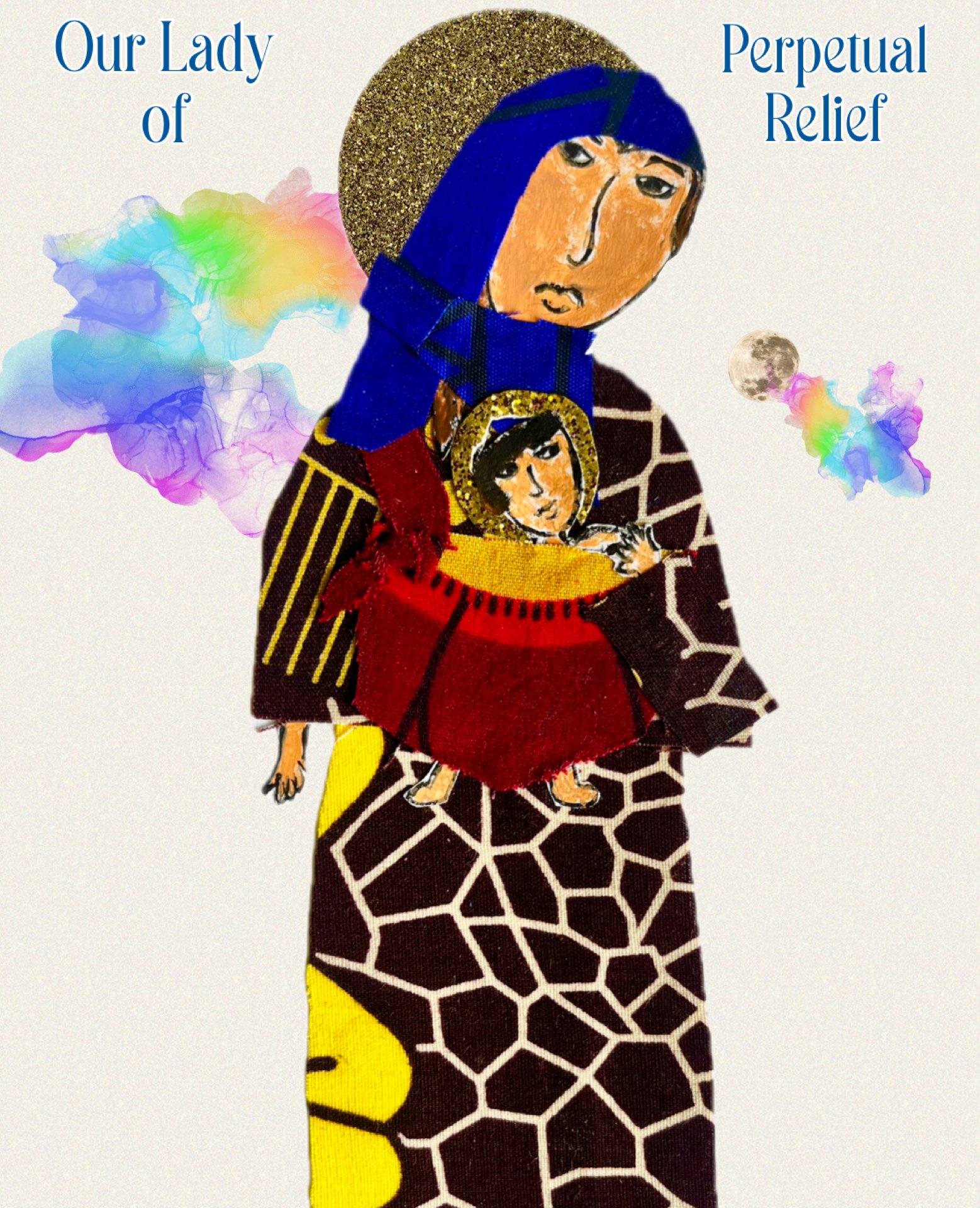
Our Mother of Perpetual Succour, or Our Lady of Perpetual Help, is a 15th-century Byzantine icon currently located at the Church of Saint Alphonsus of Liguori in Rome. This icon is known as an intercessor for miracles, protection, and physical or spiritual relief, with some traditions, including the Roman Catholic Church of Saint Alphonsus, petitioning her on Wednesdays.
Byzantine Hoodoo’s original sketch did not include the blue veil, as it wrestles with tensions between female identity and body covering. However, as I continued to read, I learned that the traditional image includes the blue veil because it was the color worn by mothers in Palestine at the time the image was created. Byzantine Hoodoo does not seek to dismiss or insist on change to anyone’s cultural commitments; however, it does call out the use of gender to control and manipulate people’s access to social thriving. Therefore, Byzantine Hoodoo’s Mary from Our Lady of Perpetual Help now wears a blue hijab in solidarity with contemporary women in the region who wrestle with the tensions between religion and politics, whose livelihoods are treated as if they are at the expense of toxic patriarchal governance.
In the traditional Perpetual Help icon, Mary also has a star on her veil as a sign of the light she brought to the world by giving birth to Jesus. The archangels Gabriel and Michael are on either side of the mother and child, with Gabriel holding the spear that pierced Jesus in his side during the crucifixion and Michael holding a cross and some nails.
Byzantine Hoodoo’s work is grounded in energy and generational wound healing and spiritual curse breaking, and has thus opted to use the halo and moon as stars with multicolored energy radiating from them, in place of the archangels Gabriel and Michael.
For one, in traditional iconography, the “Passion” narrative, or the crucifixion scene of Jesus, is elevated to draw attention to the experience described in the biblical text. In this particular icon, Baby Jesus is said to be looking up at the angels in despair, holding his mother’s hand, with a falling sandal–a symbol of him holding on for dear life.
Byzantine Hoodoo, however, bears in mind James Cone’s “The Cross and the Lynching Tree” and Delores Williams’ “Sisters in the Wilderness” – theologians who wrestled with the tensions of honoring the crucifixion, for it was the penal punishment of the day. While there are distinctions amongst traditions about using images of Jesus on the cross versus the cross by itself as celebration of his conquering death, I think I would find it terrifying to see someone wearing a necklace with a noose on it. I would rather visit a museum that speaks truth to power about what that weapon really stood for–and even then I cringe at the pictures of the lynching postcards that travelled around the Jim Crow South.
Therefore, the image writing that Byzantine Hoodoo’s Our Lady of Perpetual Relief has embraced has been done to declare that–Mary, women, we are all crowned with the Sun/ the Divine Source of all creation, and our children, this planet, our future is dependent on us telling the full story of what it means to be human in this world.
Byzantine Hoodoo also honors the practice of ancestor and orisa veneration–recognizing the different ways in which God orchestrates life, how spiritual realms interact with the physical. So for Byzantine Hoodoo, iconography is not worship nor is it making “gods” of the people; rather, it is a tool to honor the lessons that these images bear and a means to re-member ancient wisdom that can fuel our contemporary moments for future thriving. The icons provide language for specificity in prayer. Mary offered relief to her son by holding him near throughout their journey, in ways that would help him as he grew older.
So for Byzantine Hoodoo, Our Lady of Perpetual Relief is an invitation of prayer for relief from old patterns that bind us to social constructs and religious dogma that cause harm. Here is an invitation of prayer for the Divine to send out the necessary angels, orisas, and ancestors to fight on our behalf, to come to our memory through scent, vision, or any other senses when we find ourselves in need of comfort, reminders of safety, protection, etc. Here is a prayer for a miracle of healing, the release of stagnant energy causing dis-ease and/or discomfort, for a miracle of discernment and purpose-driven goals to align with our true and best selves to tap into spiritual, financial, physical, and relational wealth. Here is an invitation of prayer for the world to come together as one, for families, and governments–on the local, state, national, and global level, for faith organizations and leaders, and spouses, and teachers, and children, tech companies and financial institutions, and friends and comrades to seek out the healing needed to transform and restore our sacred duty to live in goodness, abundance, and reciprocity.
Amen and ase